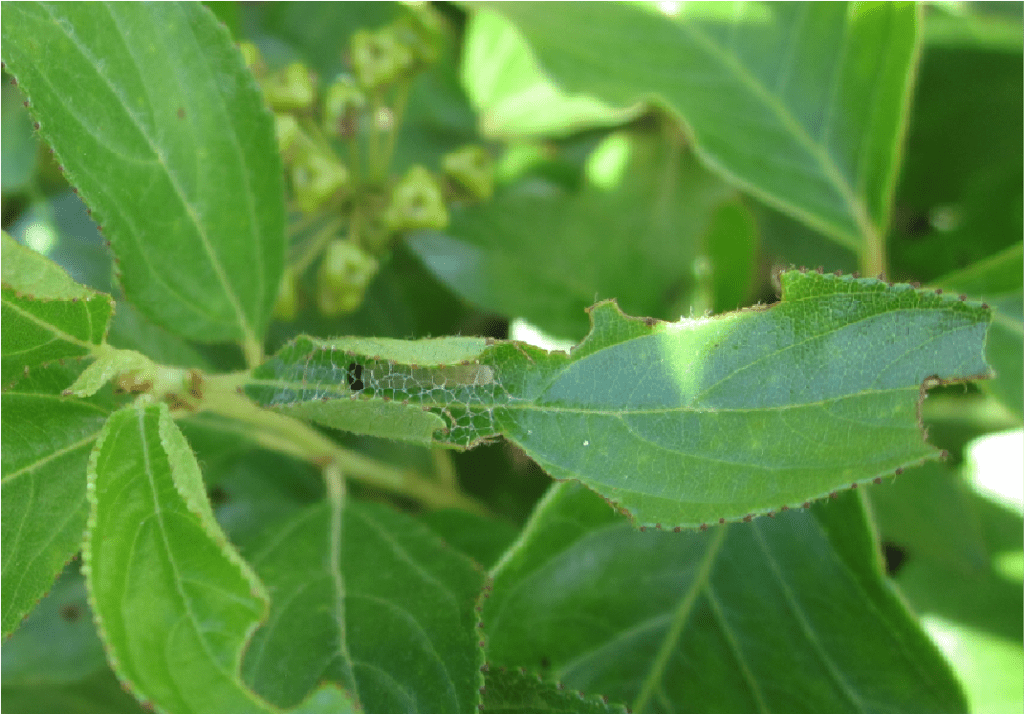
I researched egg laying and caterpillar host feeding of the endangered Mottled duskywing (Erynnis martialis) butterfly in Manitoba during 2018 through 2021 (Henault et al. 2022). This skipper lives in pine forest, alvar and other areas with well-drained soils along the Canadian-American border and south through the eastern United States (Committee on the Status of Endangered Wildlife in Canada 2012). Habitat loss and the risk of stochastic events appear to threaten existing populations. Although this skipper’s biology is more clearly understood in eastern Canada and the United States, vital components in Manitoba are not. We observed adult E. martialis egg laying in wild areas to determine egg host plants, and then watched caterpillar feeding behaviour. Mottled duskywing laid eggs on Narrow-leaved New Jersey tea (Ceanothus herbaceus), then consumed leaves of this plant species as caterpillars. Caterpillars constructed leaf shelters near the edge of plants, possibly to benefit from more nutritious leaves or specific temperatures for development (Bowers and Stamp 1993; Čelik et al. 2015). Larvae in the eastern range were observed harvesting leaves at night to eat in their shelters (Olson 2002). We think larvae in Manitoba likely behave similarly, however we need to watch larvae at night, as well as during the diapause date threshold, to generate evidence. The manuscript can be read at this direct link:
Manuscript
Journal website
Henault, J., Norris, D.R., Linton, J.E., and Westwood, R. 2022. Adult oviposition, larval host plants and shelter use of the endangered Mottled duskywing (Erynnis martialis) in Canada. The Journal of the Lepidopterists’ Society, 76: 43-55. https://doi.org/10.18473/lepi.76i1.a6; addendum 2022, 76:160. https://doi.org/10.18473/lepi.76i2.a11.
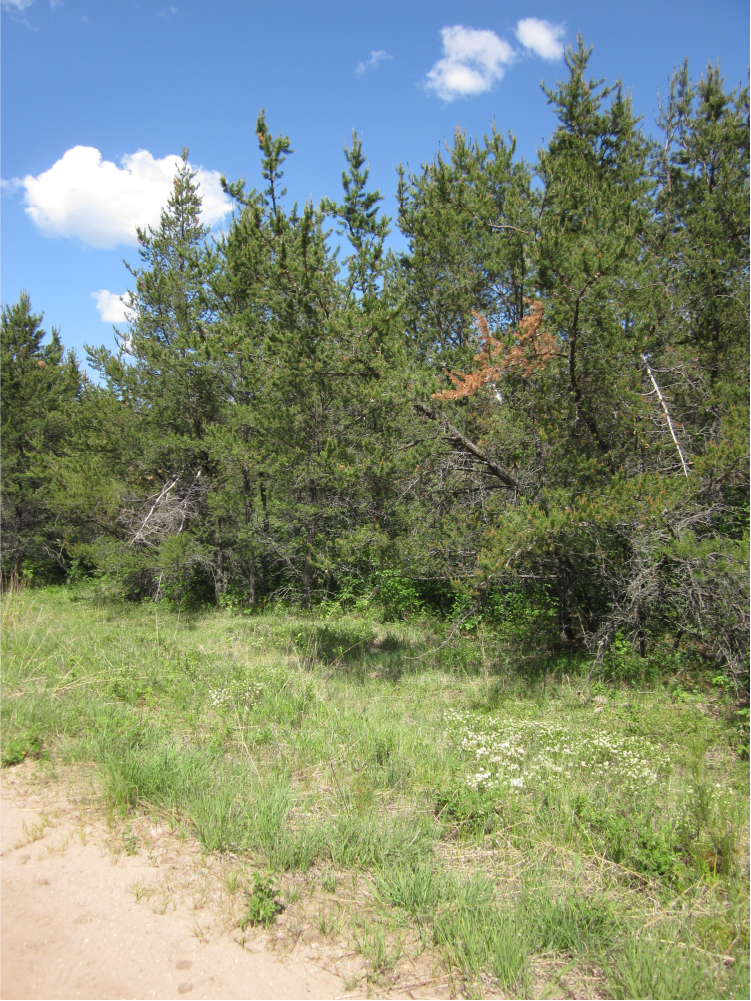
P. banksiana, narrow clearing, abundant C. herbaceus
But where does Mottled duskywing live in Manitoba, and what habitat attributes support this skipper? We then surveyed possible E. martialis locations in southeastern Manitoba (the south basin of Lake Winnipeg east to Nopiming Provincial Park, south to the Canadian-American border). At a subset of locations, we recorded habitat attributes (including the width of forest clearings, tree age, number of C. herbaceus plants and diversity of butterflies as well as moths) before comparing areas we found Mottled duskywing to those we did not. We found an apparently unreported E. martialis population, almost simultaneously with a butterfly photography group (Deanna Dodgson and partners 2021)! We observed E. martialis egg and larval microhabitats closer to the sun-exposed side of sites while adult basking locations to the middle of sites. Areas where we found E. martialis had narrower clearings between trees, were older and supported more C. herbaceus plants. Jack pine (Pinus banksiana) typically were the most common trees where we observed Mottled duskywing. We are currently preparing this manuscript (Henault and Westwood in preparation 2021), and I will post updates!
In 2021, Jordan Ross featured my research contributions in The Carillon, a news outlet for southeastern Manitoba. I tried to highlight opportunities for community members, researchers, commercial industries and government to steward sandy, pine-forest habitat for all folks. Please see this link to the article below!
Ross, J. 2021. Rare butterfly in Sandilands. The Carillon, Volume 76, Number 27 (8 July 2021), Pp. A13. https://www.winnipegfreepress.com/the-carillon/local/Rare-butterfly-studied-in-Sandilands-574812331.html (accessed 12 July 2021).
I led a discussion (collaborating with Dr. Richard Westwood) of host food ecology and required habitat, as well as communicated opportunities to create habitat for endangered wildlife, provide cultural needs, enable recreational opportunities and commercial activities simultaneously in an online Nature Manitoba article. The article is available for everyone to read below.
Henault, J. and Westwood, R. 2021. The Mottled duskywing butterfly in Manitoba. Nature Manitoba June issue. https://naturemanitoba.ca/news-articles/endangered-mottled-duskywing (accessed 10 June 2021).
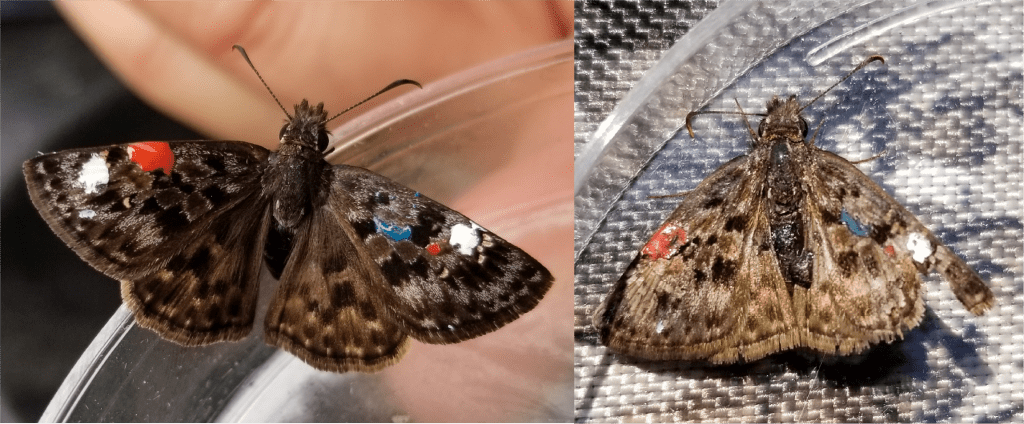
Dr. Richard Westwood and I collaborated with Dr. Ryan Norris (University of Guelph) and Jessica Linton (Natural Resource Solutions Inc.) to research adult longevity, dispersal capacity and genetic similarities to populations in Ontario, in Manitoba (2019). We captured some adults, marked them with unique nailpolish patterns and noted when we observed the same individuals. We observed the same adults several days after we released them, and discovered individuals fly a substantial distance! We hope to communicate detailed results in 2022.
I continue to survey E. martialis and contribute to research efforts with the Canadian Wildlife Service (Environment and Climate Change Canada). In 2021, I surveyed locations for E. martialis and C. herbaceus (host plant) abundance, found previously unknown surveys and verified previously prepared specimens. Please see my CV for further details of my Canadian Wildlife Service research. I hope my efforts, building with those of everyone else, will reduce the chance of E. martialis extinction in Manitoba and inspire folks to explore wild places near them!
References
Bowers, M. D., & N. E. Stamp. 1993. Effects of plant age, genotype, and herbivory on Plantago performance and chemistry. Ecology 74:1778.
Čelik, T., M. Bräu, S. Bonelli, C. Cerrato, B. Vreš, E. Balletto, C. Stettmer, & M. Dolek. 2015. Winter-green host-plants, litter quantity and vegetation structure are key determinants of habitat quality for Coenonympha oedippus in Europe. J. Insect Conserv. 19:359–375. https://doi.org/10.1007/s10841-014-9736-3.
Committee on the Status of Endangered Wildlife in Canada. 2012. COSEWIC assessment and status report on the Mottled duskywing Erynnis martialis in Canada. Committee on the Status of Endangered Wildlife in Canada, Ottawa, Canada. xiv+35 pp.
Olson, S. 2002. Conservation assessment for Mottled duskywing (Erynnis martialis). Eastern Region, USDA Forest Service. 9 pp.
 Justis Henault