During my BSc Honours thesis (Biology; University of Winnipeg), I researched whether potential Poweshiek skipperling (Oarisma poweshiek) butterfly host plants were associated with butterfly abundance (supervisor: Dr. Richard Westwood). The Poweshiek skipperling is a globally endangered butterfly, only supported by tall grass prairie ecosystems (Committee on the Status of Endangered Wildlife in Canada 2014; United States of America Fish and Wildlife Service 2015; Canada Gazette 2019; Royer 2020 – International Union for the Conservation of Nature). The destruction of tall grass prairie during the last several hundred years has resulted in declines of Poweshiek skipperling in Canada and the United States. In 2016, I enumerated host plant stems and measured vegetation architecture (including plant height, estimated flower percent cover) within the Manitoba Tall Grass Prairie Preserve. I then compared these habitat attributes between locations with different Poweshiek skipperling adult abundances. I found that high abundance O. poweshiek locations were drier than lower abundances (indicated by plant species), likely supporting plants that adults and larval consume (nectar plants and host graminoids) (Henault 2017).
Please contact me for a copy of my honours thesis and I will gladly share it!
Henault, J. 2017. Association of the endangered Poweshiek Skipperling (Oarisma poweshiek) with potential larval host plant species in Manitoba. Bachelor of Science Biology Honours thesis, University of Winnipeg, Winnipeg, Manitoba, Canada.
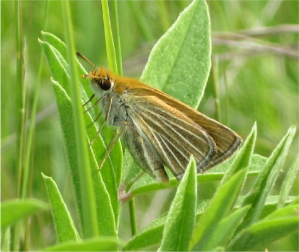
After I completed this research, I was curious about caterpillar foraging. Where did adults lay eggs and what plants did caterpillars eat? Researchers in Canada and the United States did not have a clear idea of larval host plants at the time. These questions then became the focus of my MSc thesis, conducting fieldwork from 2017-2019 (Bioscience, Technology and Public Policy, University of Winnipeg). I followed adults in prairie patches to identify locations in which various activities, such as egg laying or nectar feeding, were facilitated by the habitat. I then placed plastic ring enclosures around egg laying locations (hopefully to prevent larva from escaping while still maintaining prairie conditions of wild caterpillars) before observing their foraging behaviour. I measured vegetative, structural and microclimatic attributes of microhabitats to determine potential characteristics which facilitate various adult activities and larval development.
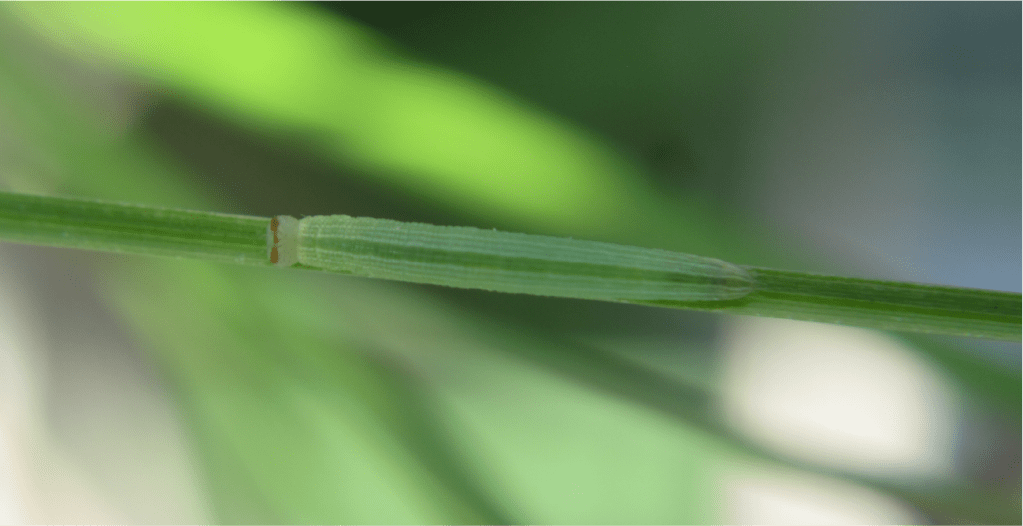
Larvae appeared to navigate microhabitats to locate host food plant species, alternating between shoots of various species throughout their development. Adults flew almost exclusively in the prairie plant community, rarely flew in shrub or ephemeral wetland communities and were never observed flying in wetland or forest communities. Adult activities appeared to be distributed along a soil moisture gradient, with egg laying associated with the mesic section of the moisture gradient, resting and/or basking associated with the drier section and nectar feeding generally associated with sections throughout the moisture gradient.

Discoveries from my research may guide habitat stewardship to ensure that high quality habitat is available for every life stage and inform reintroduction activities to ensure potential release locations contain required habitat features.
Publications from my thesis and my thesis itself can be seen at the links below:
Read-only link to published manuscript: https://rdcu.be/dkqwo
Accepted manuscript direct download
Now with a greater understanding of larval foraging and adult interactions, the Poweshiek skipperling community may hopefully generate potential causes which explain O. poweshiek’s decline and identify possible solutions to facilitate its successful recovery! Hopefully this research may aid the recovery efforts that focus on other Lepidopterans-at-risk.
I collaborate with local and international conservation experts in academia, non-profits and multiple levels of government as a Co-Chair of the Science Support Team and Member of the Steering Committee of the Poweshiek skipperling International Partnership (PSIP) to prevent the extinction of this butterfly. Explore recovery efforts at our website and ArcGIS Story Map.
Jaimée Dupont-Morozoff, Richard Westwood and I assessed the consequences of various habitat management strategies to determine if any / which were likely to maintain habitat quality for O. poweshiek (Dupont-Morozoff et al. 2022). At locations that had been left idle, grazed or burned from 1 to > 15 years before the study, we measured abundances of adult Poweshiek skipperlings and characteristics of the vegetation and soil. We found that locations which had been burned 4-6 years before the study were the most supportive for O. poweshiek. Consequentially, burns prescribed at this frequency were recommended to habitat stewards to support and recover the current population and possibly newly established populations.
Our paper can be read at the publisher’s website (with membership) or institutional repository (openly accessible).
Dupont-Morozoff, J.M., Westwood, R. and Henault, J. 2022. An assessment of prairie management practices for maintaining habitat quality for the endangered Poweshiek skipperling butterfly in Canada. The American Midland Naturalist, 188: 74-101. https://doi.org/10.1674/0003-0031-188.1.74. Institutional repository OA: https://winnspace.uwinnipeg.ca/handle/10680/2032.
An article communicating larval and adult ecology, as well as recent conservation efforts I co-authored (with Dr. Richard Westwood) can be acquired from The Prairie Garden publication.
Henault, J. and Westwood, R. 2020. Protecting the Poweshiek skipperling; an endangered butterfly in Manitoba. The Prairie Garden 2021. Pp. 165-168.
Contact me with questions / comments / clarifications about anything above and I will eagerly address them!
References
Canada Gazette. 2019. Canada Gazette, Part II.
Committee on the Status of Endangered Wildlife in Canada. 2014. COSEWIC assessment and status report on the Poweshiek skipperling Oarisma poweshiek in Canada. Committee on the Status of Endangered Wildlife in Canada, Ottawa, Canada. Available from https://species-registry.canada.ca/index-en.html#/species/796-333 (accessed 13 February 2021).
Royer, E. 2020. Oarisma powesheik (amended version of 2019 assessment). International Union for Conservation of Nature and Natural Resources. The IUCN Red List of Threatened Species: e.T122914337A166163683. https://doi.org/10.2305/IUCN.UK.2020-1.RLTS.T122914337A166163683.en. (accessed 31 March 2021).
United States of America Fish and Wildlife Service. 2015. Endangered and threatened wildlife and plants; designation of critical habitat for the Dakota Skipper and Poweshiek Skipperling. Department of the Interior, Federal Register, 80: 59247-59384.
 Justis Henault